
Simple Cleansing Oil Formulation
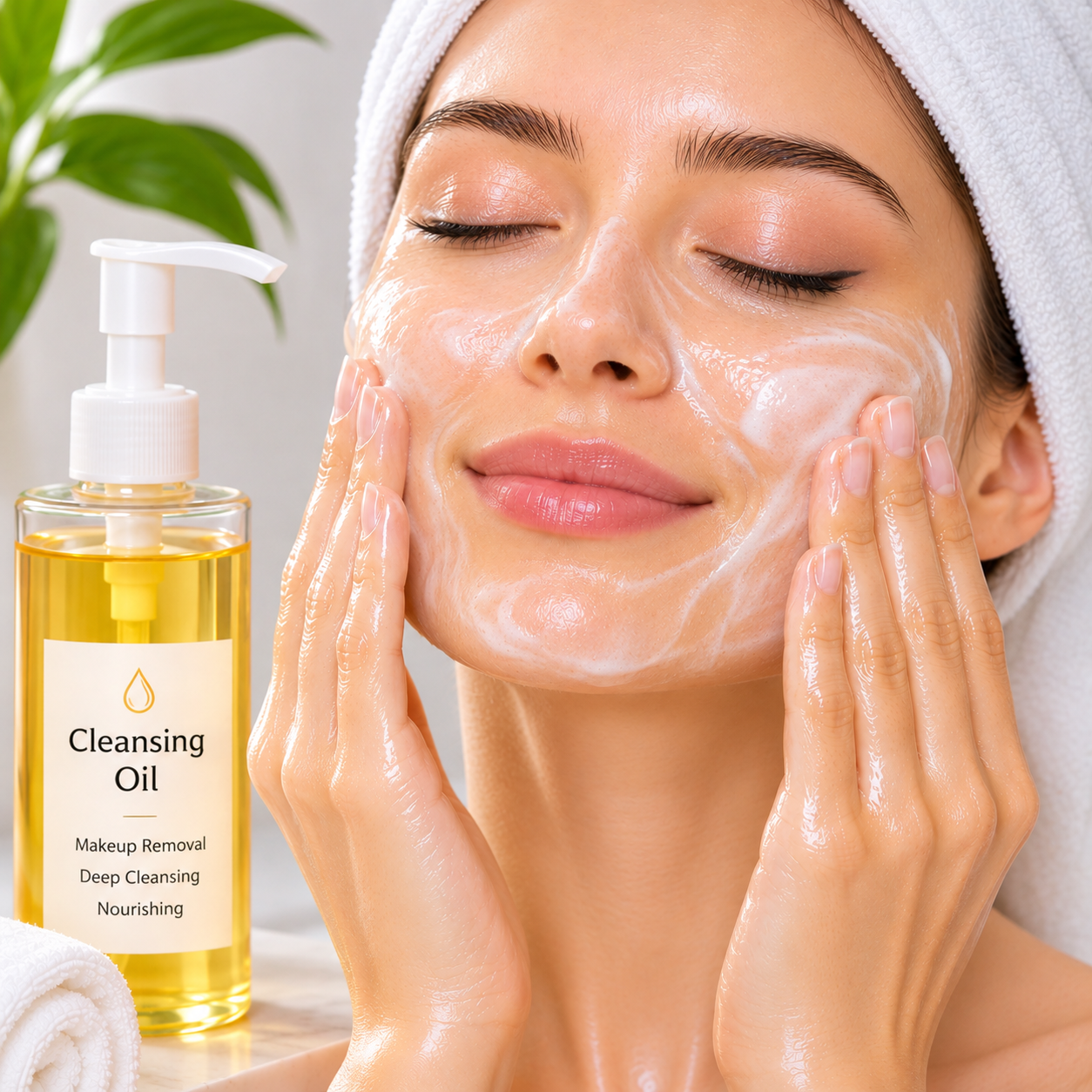
An effective cleansing oil and makeup remover can be formulated using just three carefully selected ingredients. This straightforward formulation combines the nourishing and emollient properties of refined almond oil with the lightweight sensory characteristics of caprylic/capric triglycerides and the emulsifying performance of PEG-20 Glyceryl Triisostearate.
Typical Formulation:
- 55–70% Refined Almond Oil – Acts as the primary emollient, helping to dissolve makeup, sebum, and oil-soluble impurities while leaving the skin feeling soft and conditioned.
- 20–30% Caprylic/Capric Triglyceride (MCT Oil) – Provides a lightweight, silky feel, enhances spreadability, and leaves a soft, smooth finish with a less greasy after-feel.
- 5–15% PEG-20 Glyceryl Triisostearate – Functions as a self-emulsifying emollient, allowing the oil-based cleanser to form a milky emulsion upon contact with water, facilitating easy rinsing.
Preparation Method
All three ingredients are low-viscosity liquids, making this formulation particularly easy to prepare without heating. Simply combine the ingredients at room temperature and mix thoroughly for several minutes until a uniform, homogeneous blend is obtained. Adjust the individual ingredient concentrations to ensure that the total formulation equals 100%. To improve oxidative stability and extend the product’s shelf life, a small amount of an antioxidant, such as vitamin E (tocopherols), may be incorporated. Since the formulation is entirely oil-based and contains no added water, a conventional antimicrobial preservative is generally not required, provided that appropriate manufacturing, packaging, and storage conditions are maintained.
Application and Cleansing Performance
The cleansing performance can be evaluated shortly after preparation. Apply a small amount of the cleansing oil to dry skin and gently massage over the face to dissolve makeup and accumulated impurities, taking care around the delicate eye area.
Next, moisten your fingertips with water and continue massaging. The oil will gradually transform into a light, milky emulsion as the emulsifier interacts with water. The resulting emulsion can then be rinsed away, leaving the skin feeling clean, soft, and comfortable.
Formulation Flexibility
One of the key advantages of cosmetic formulation is the flexibility to tailor ingredients to specific requirements. The proportions and types of oils and emollients can be adjusted according to the desired sensory profile, raw material availability, cost considerations, and overall product positioning.
By selecting suitable alternatives and optimizing ingredient ratios, formulators can develop customized cleansing oils with different textures, spreading characteristics, and after-feel while maintaining the essential cleansing and self-emulsifying functionality of the formulation.
Commercial cleansing oil products
Are you still convinced that a commercial product has to be complicated to be effective?
Example 1:
Let’s take a look at the ingredient list of a commercially available oil cleanser:
- Prunus Amygdalus Dulcis (Sweet Almond) Oil
- Polyglyceryl-4 Oleate
- Tocopherol
- Helianthus Annuus (Sunflower) Seed Oil
Not particularly complicated, is it?
To the best of our knowledge, Polyglyceryl-4 Oleate is a more expensive alternative to PEG-20 Glyceryl Triisostearate, with both ingredients serving essentially the same function in an oil cleanser.
Furthermore, Tocopherol in the concentrated form is commonly supplied in sunflower seed oil, meaning these two ingredients are often purchased together as a single raw material. So, what appears to be a four-ingredient formulation may, in practice, involve just three distinct raw materials, with two of the listed ingredients supplied as one.
The takeaway:
A commercially successful product doesn’t necessarily require a complex formulation. Sometimes, simplicity is all it takes.
Example 2:
- Olea Europaea (Olive) Fruit Oil
- Caprylic/Capric Triglyceride
- Sorbeth-30 Tetraoleate
- Pentylene Glycol
- Tocopherol
- Stearyl Glycyrrhetinate
- Rosmarinus Officinalis (Rosemary) Leaf Oil
- Phenoxyethanol
Although the full ingredient list is somewhat longer, the fundamental formulation concept remains largely the same. Olive Oil replaces Sweet Almond Oil, while Caprylic/Capric Triglyceride (MCT oil) and Tocopherol are retained as key formulation components. Sorbeth-30 Tetraoleate serves as another self-emulsifying ingredient, offering an alternative to PEG-20 Glyceryl Triisostearate or Polyglyceryl-4 Oleate.
The remaining ingredients may contribute additional benefits, such as improving the sensory profile and after-feel, providing skin soothing properties, and supporting the product’s antimicrobial stability.
The takeaway:
Despite differences in the individual ingredients, the underlying formulation approach is remarkably similar. A few carefully selected raw materials form the foundation of an effective cleansing oil, while additional ingredients help refine its sensory properties and overall performance.