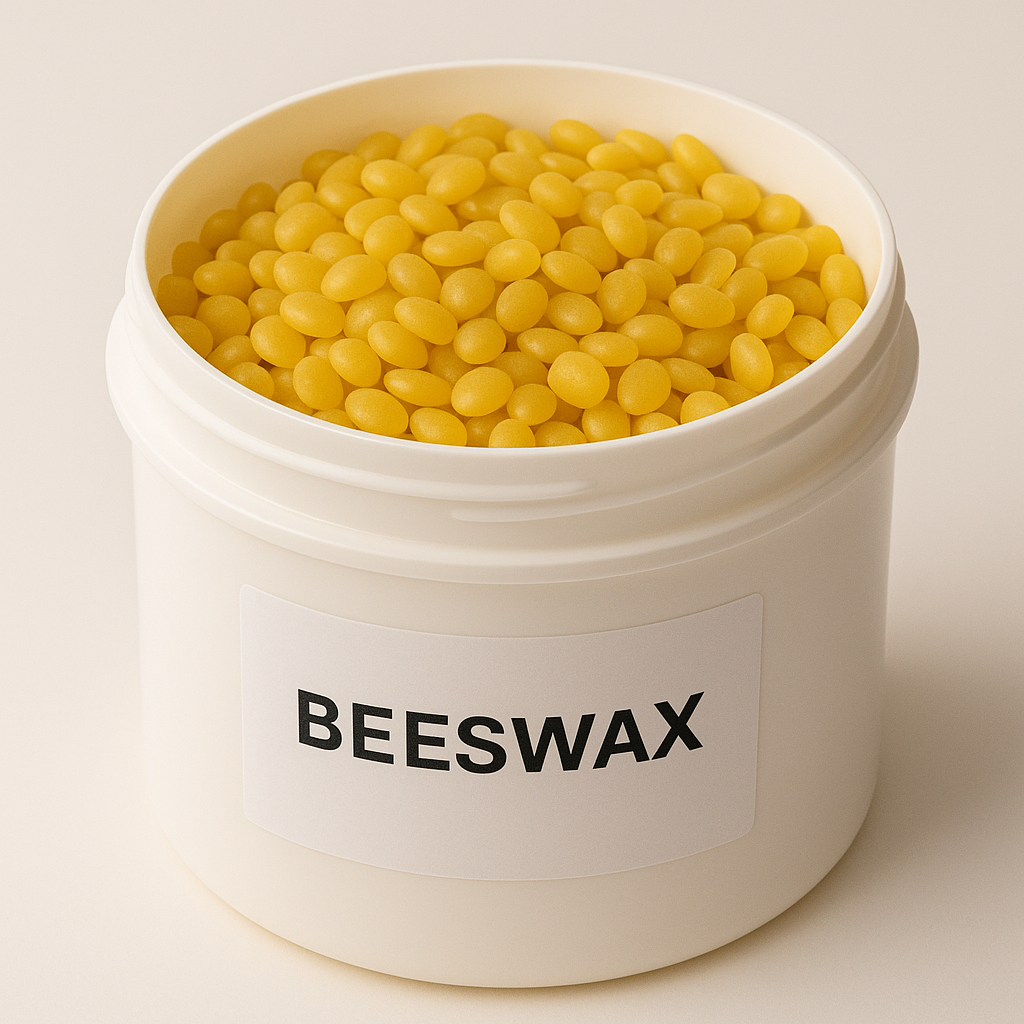

Beeswax (yellow) is a natural wax produced by the honey bee, Apis mellifera. Widely used in cosmetics and skincare, beeswax acts as an emulsifier, emollient, thickener and stabilizer. Its ability to provide structure, viscosity and a protective skin feel makes beeswax a versatile ingredient in creams, lotions, balms, lipsticks and other personal care products.
Appearance and Composition
The color of beeswax can range from light yellow to medium yellow and dark brown. It is influenced by fat-soluble carotenoids and other pigments originating from pollen and propolis. At room temperature, beeswax is a solid material with a characteristic natural aroma often associated with honey and other bee products.
Its composition and physical properties give beeswax the ability to provide structure, consistency, and stability to a wide range of formulations.
Properties and Benefits
One of the key properties of beeswax is its ability to increase viscosity and provide body and stiffness. This makes it particularly useful in creams, lotions, body butters, ointments, balms, and other semi-solid products.
Beeswax also provides rich conditioning properties and promotes good adhesion to the skin. In cosmetic formulations, it can contribute to a smooth skin feel while forming a thin protective layer that helps reduce moisture loss.
Its multifunctional properties allow formulators to use beeswax to achieve several effects within a single formulation, including:
- Structure and viscosity: provides body, firmness, and consistency to creams, lotions, balms, ointments, and body butters.
- Emulsion support: contributes to the stability and texture of emulsions.
- Skin protection: forms a protective, non-occlusive film that helps reduce moisture loss.
- Conditioning: contributes to a smooth and pleasant skin feel.
- Adhesion: improves the ability of formulations to remain on the skin and lips.
- Texture modification: helps create the desired consistency and firmness.
- Product stability: can contribute to the physical stability of cosmetic formulations.
Applications of Beeswax (Yellow) in Cosmetics and Skincare
Beeswax is a versatile cosmetic ingredient widely used in skincare and personal care formulations. Its natural structuring, conditioning, protective, and stabilising properties make it suitable for a broad range of cosmetic products.
In creams, lotions, ointments, balms, and body butters, beeswax provides body, viscosity, consistency, and firmness while contributing to a smooth and comfortable skin feel. It can also form a thin, non-occlusive protective layer on the skin, helping to reduce moisture loss and improve the adhesion and persistence of skincare formulations.
Beeswax is particularly valuable in lip care products, including lip balms and lipsticks. It provides the structure needed for stick and semi-solid formulations while contributing to gloss, application properties, and colour stability. Beeswax is also used in soap formulations, where it can increase hardness and help create a longer-lasting bar.
For a more in-depth overview of the use of beeswax in skincare, see the published review:
https://onlinelibrary.wiley.com/doi/10.1111/jocd.15718
Oil Structuring and Gelation
In addition to its use in conventional cosmetic formulations, beeswax can modify the physical properties of oils. Relatively small amounts can induce gelation in sunflower oil. This occurs because the fatty components of beeswax crystallize and form a three-dimensional network that traps the liquid oil:
https://ifst.onlinelibrary.wiley.com/doi/abs/10.1111/ijfs.14370
This ability to structure oils demonstrates the versatility of beeswax and its potential for creating different textures and consistencies in cosmetic formulations.
Safety and Regulatory Status
Beeswax has a long history of use in food, cosmetics, and pharmaceutical preparations. It is considered safe for human consumption and is authorized as a food additive under European Union food regulations.
When consumed, beeswax is largely resistant to digestion and passes through the digestive system. Its ability to act as a matrix for other substances, with incorporated compounds potentially being released gradually, has also contributed to its use in pharmaceutical and medicinal preparations.