
Glycerin and glycerol are almost the same, but there’s a small difference. Glycerol is the pure form, while glycerin usually contains a bit of water and tiny amounts of other ingredients. That’s why the term “glycerin” is commonly used for the version found in most skincare products. An interesting fact is that a mixture of 66.7% glycerol and 33.3% water freezes at -46.5 °C. This is due to a phenomenon known as supercooling, which is useful in cryopreservation applications.
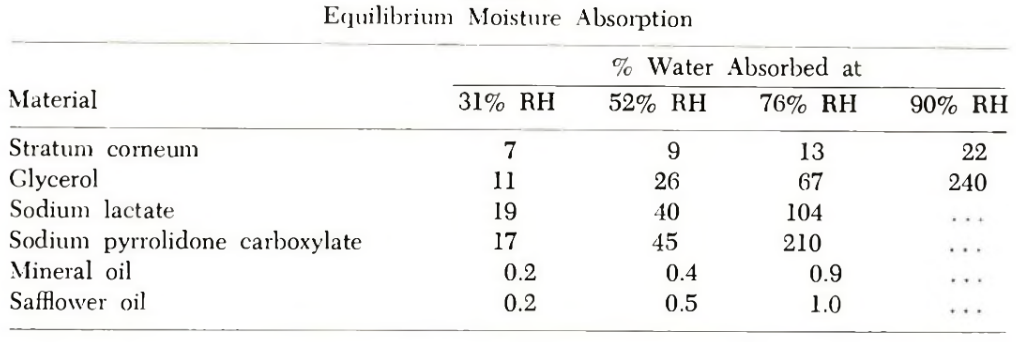
Glycerin is highly effective at drawing moisture from the air, making it an excellent and versatile moisturizing agent. Its hygroscopic nature becomes especially pronounced at high relative humidity (RH) levels. The table below compares the moisture absorption properties of various materials.
Once applied it easily absorbs into the outer layer of the skin (the stratum corneum) and helps lock in hydration. Because of this, it’s often used as the gold standard for comparing other moisturizing ingredients. In cleansers, it also helps leave the skin feeling soft and smooth.
Glycerin is generally safe, gentle, and non-irritating. However, in its pure water-free form, it can actually draw too much moisture from the skin, which may lead to dryness.